Sebaldian Times
More thoughts on W.G. Sebald, The Emigrants, Memory

As a kid one of my favorite games was Memory. The game begins with all the tiles facing down. Each turn a player turns over two tiles. If the two tiles match, that player keeps them. The player with the most memories collected at the end of the game wins. Growing up in West Germany meant I had a Ravensburger set like this one:
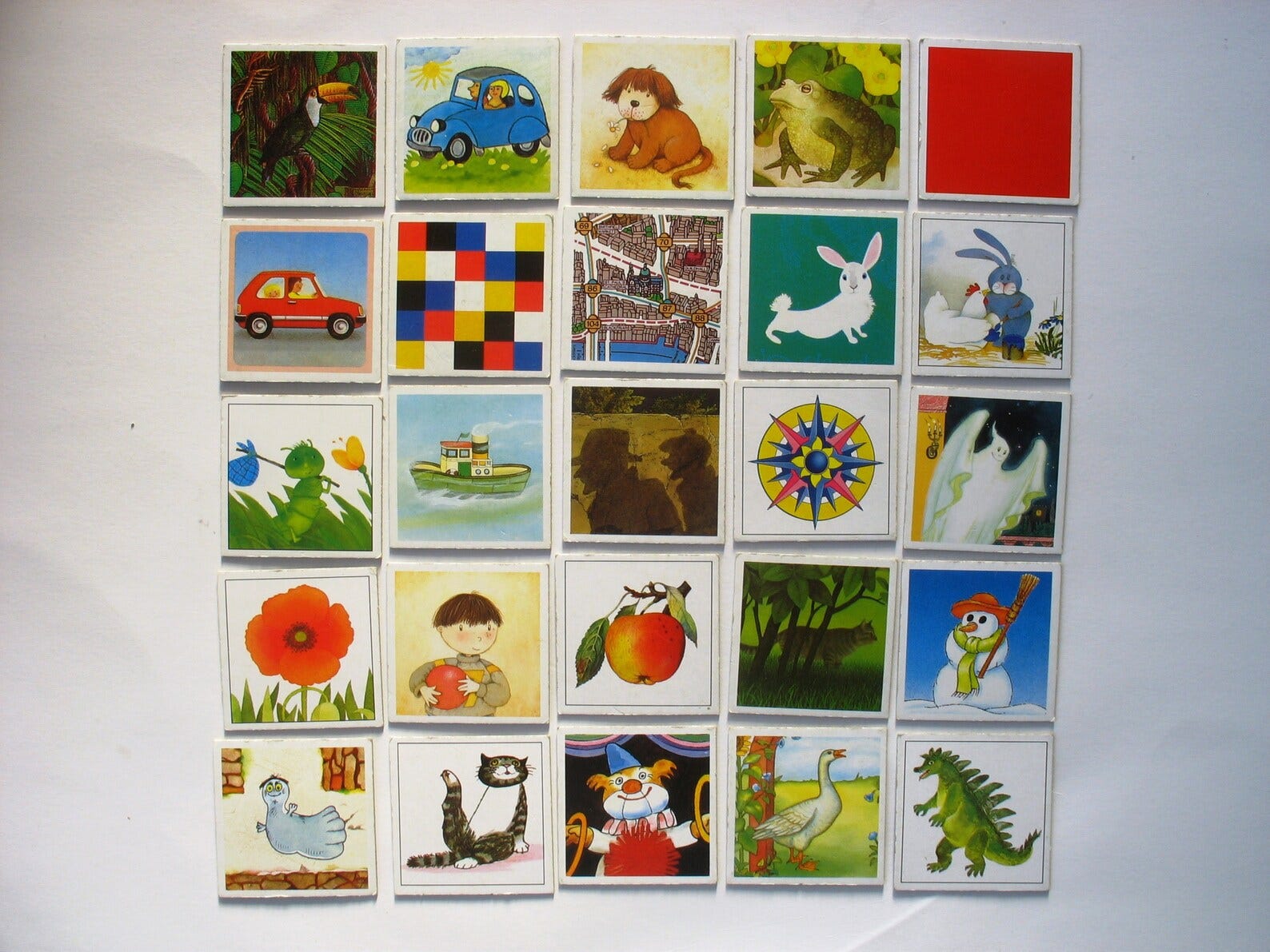
It felt like everything in life could be found in these square images—and from a kid’s perspective it’s true: there is not much more outside of cats, ducks, cars, boats, planes, red balls, ghosts, fruit, and menacing shadows. Many of these images were taken from different children’s picture books. My favorites were the two ghosts. The one, on the right had classic “Gespenst” vibes (now replaced for me by unfortunate Ku Klux Klan vibes) while the one in the bottom left-hand corner depicts a doofy, slightly more mischievous ghost that I don’t not share a resemblance with these days.
It also gave me an early introduction to aesthetics. The card featuring multi-colored squares in a Bauhaus style inspired by Mondrian, the nature scenes, the still lifes, the comic, the picturesque, all in different styles, perspectives, and tones. In Emigrants and Austerlitz Sebald plays with something we could call the aesthetics of memory. Which is really just an annoying way of saying the aesthetic quality of something remembered differs from the quality of something lived. They are two completely different experiences of the same event, one in real-time, the other after the fact. What’s compelling to me are the ways in which something remembered can become beautiful or picturesque in the process of being remembered. Because the act of remembering something, good or bad, is an act of reverence. The remembered entity or event takes on a special sheen just by being remembered and revered, as if you could make something beautiful simply by remembering it, no matter how mundane (or awful) the thing was when it happened.
Lately, my relationship to memory (my memories that is, not the game) has shifted. Bouts of anxiety and depression make it feel as though certain thoughts and memories are inaccessible. Like museum exhibits that are closed to the public, I know the memories are there, behind the curtain somewhere. The brain science behind this, as I understand it, involves an overactive fight or flight response that temporarily shuts down parts of the brain that would not be useful in a life or death situation. No need to remember in those moments that あなたの means “your” in Japanese or about that one time I got into a car with four strangers on their way to a Denny’s.
All the way back in 2021, Elisa Gabbert led a virtual book club for The Emigrants over at A Public Space. Many of her brief posts discuss memory in some way, which makes sense because memory is the black hole at the center of the four stories (novellas?) in The Emigrants. The epigraph at the beginning of the first section, Dr. Henry Selwyn, reads, And the last remnants memory destroys. Turn the page and the first thing you see are not words but a photograph, or in other words, a memory. The photo is of a large oak tree in a cemetery. It all feels a bit on the nose now as I write about it, a bit too Sturm und Drang, but nothing could be more fitting for this book. Anything else would be a false note. And it functions as a warning more than anything else, it says, if you were hoping to read a book about the living, I’m sorry but you’ll have to look elsewhere.

Which isn’t to say it is a book about death, on the contrary, it’s a book that feels very much alive, but only insofar as it’s about the pain of living, or living with the dead. As the narrator famously says toward the end of the first story, “And so they are ever returning to us, the dead.” But the best part of this moment is not that line, but what comes after it: “At times they come back from the ice more than seven decades later and are found at the edge of the moraine, a few polished bones and a pair of hobnailed boots.” It’s easy to read that first line and think ah yes, he’s speaking profoundly about memory and ghosts here, and he is on some level, but he also, funnily, means it quite literally, as the glacier gives up Naegeli’s remains back to the air.
A week or so has gone by since finishing The Emigrants but it has led me to wonder, was I sad before I read this book? Or did the book make me sad? Or did the book simply allow me to feel that sadness in a way I hadn’t felt it before? Probably all three, if I’m being honest. These stories are all in some way about a sense of belonging, something I’ve been struggling with for awhile now, not feeling at home in America, not feeling at home in Germany either. A bit unsettling then, that suicide is a recurring theme, fused to the twins of memory and loss.
In the second section, sight and memory are linked: Paul Bereyter loses his eyesight and sees only “fragmented or shattered images.” A few lines later though he “looked back with immense gratitude” on an operation that extended the number of years he could see (I’m curious how literal the translation is, if the German is in fact something like “blickte zurück”). This kind of gallows humor can be found throughout the novel if you’re looking for it, but Sebald doesn’t ever shift gears into a fully humorous mode, instead, it’s as if there is Sebald the serious writer who is in charge for 95% of the time, but when his attention is averted for any amount of time a mischievous side of Sebald takes the wheel for a moment or two.
It’s not unlikely that an author this fond of including photographs in his fiction would find the loss of one’s vision a particularly cruel fate, one in which the afflicted person would live in a kind of ghostly world built out of memories from the time when they could still see. It could be said that in the end it’s enough to make Paul lie down on those set of railroad tracks.
The remaining two sections are equally bleak although the third section on Ambros Adelwarth is perhaps the most lively of the four. In it, Cosmo Solomon and Ambros travel across Europe and the near east, then going as far as Jurusalem. Cosmo has a preternatural gift for gambling, or perhaps supernatural is more apt. In any case, his mental health deteriorates to the point of death, a sort of side-effect or counter to his incredible luck. By the end, Ambros’s mind has also deteriorated (although it might be accurate to say his spirit has evaporated) but in a much slower fashion, over a longer period of time, leading to a self-imposed death by electroshock therapy administered across many years.
One of the few joys of reading Sebald, if we can call them that, (or multiple works by any author worth reading more than once) is learning about their obsessions as well as the moves they rely on as writers. One of Sebald’s “moves” or habits, is to introduce characters who commandeer the narrative, like competing conductors riding on the same train. The narrator in Emigrants spends most of their time relaying someone else’s narration but there’s always the same unnamed Sebaldian narrator who exists in the margins, who makes up the frame of the story. In a way, it’s related to a conflict that’s inherent to the stories Sebald wrote: who has the right to tell the stories of persecuted or exiled Jews? Or to put it another way, who should speak for the dead? The answer, in Emigrants anyway, is anyone but “the narrator.”
I wrote about the aesthetics of memory earlier here, how there’s something inherently beautiful about a memory, but there’s also something inherently painful about a memory, whether it’s good or bad. A bad memory is bad for obvious reasons, and it’s a pain that can grow over time—has a saying ever been more wrong than “time heals all wounds”?—but even a good memory, or nostalgia in general, comes with its own special brand of pain or loss. That good moment is gone and it will not return, not by remembering it and certainly not by trying to relive it, which often makes things worse. That pain is the price of memory, but when you add it all up it still seems like a bargain for the ability to see, however imperfectly, through time into the past.